Who you are changes the answer.
The Ordinary's Retinol 1%, read with no conditions set. Thirteen ingredients, none of them flagged.
Scan any beauty product and Truva reads the whole label against your profile, not a generic list.
An ingredient list is not an answer. It’s sixty names you don’t recognise and a decision you have to make in the aisle.
Most advice is written for everyone, which means it’s written for no one. Truva starts from your situation and tells you which of those names actually matter for you.
The Ordinary's Retinol 1%, read with no conditions set. Thirteen ingredients, none of them flagged.
Read the Retinol 1% tube for PCOS and BHA is flagged for possible hormone interference. That read scores 57. How strict a read you want stays your call.
The same tube in a second trimester. Retinol carries a known birth defect risk, so Truva flags it to avoid and says Not Recommended.
See what is behind one flagTap any flag and Truva opens the ingredient. Retinol reads avoid in pregnancy and while breastfeeding, safe for PCOS and general use.
What retinol does, what ACOG and the American Academy of Dermatology say about topical use, and where the evidence runs out. It names the uncertainty rather than writing around it.
Then the aliases. Vitamin A, retinyl palmitate, all-trans-retinol: three names for one ingredient, and one scan that catches them all.
See where the answers come fromSend the whole read, not a screenshot.
Share a product and Truva writes it out as a report. The verdict and the score on the first page, every ingredient on the second, with the flagged one named and the reason spelled out. It opens anywhere, with no app needed to read it.
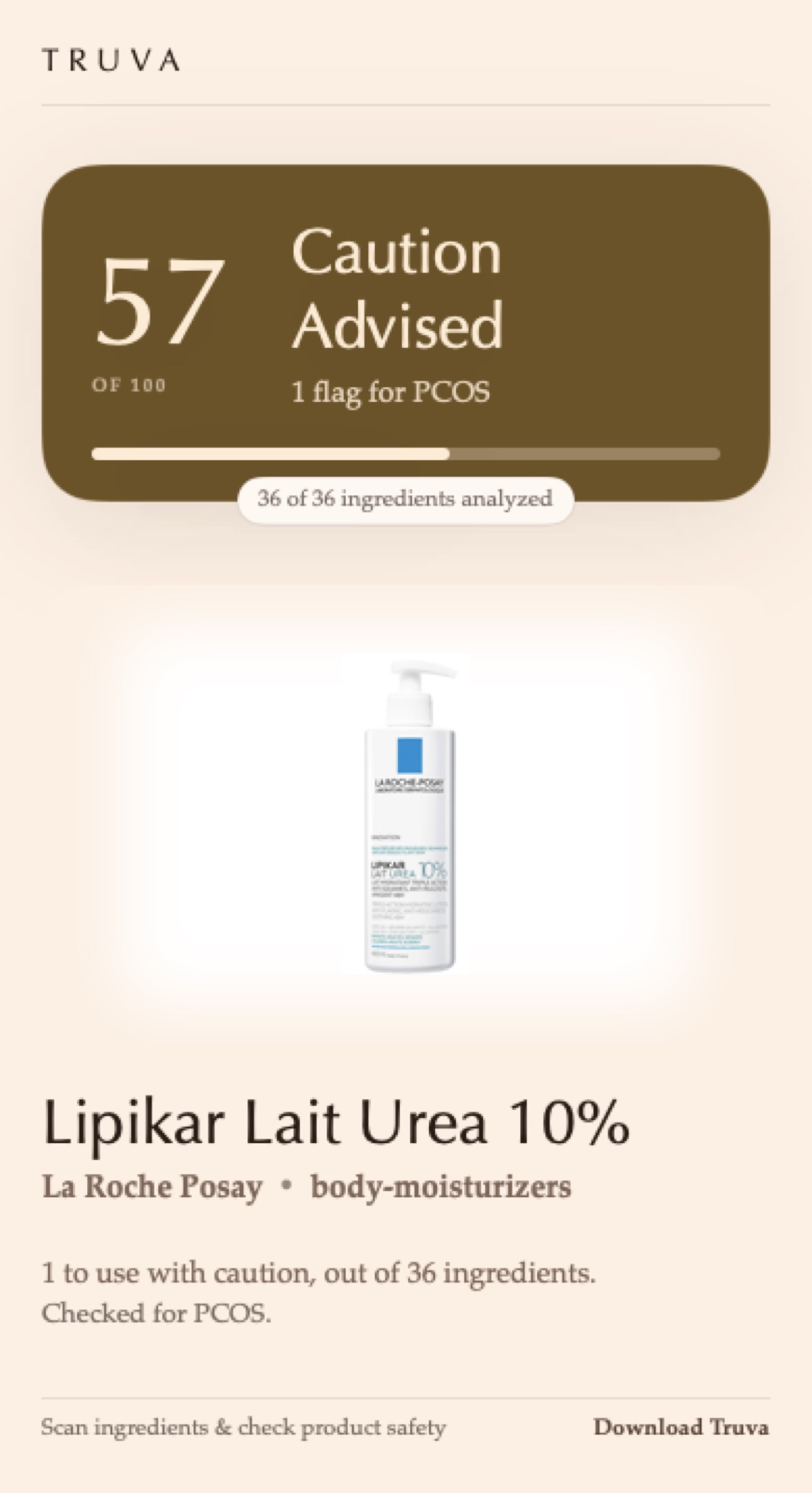 Open the sample reportPDF · 2 pages
Everything you own, already read.
Add a product to your shelf and it keeps its answer. Open the app and the whole shelf is there, each product still carrying the verdict for your profile, so you are not re-scanning what is already in the bathroom.
No scare statistics. Ever.
Truva tells you what published guidance says about the product in your hand, names the body that said it, and links out so you can read the original. Where the evidence is thin, it says so.
Truva summarises published ingredient guidance. It doesn’t know your medical history, and it isn’t a substitute for your doctor or midwife. Bring it to your appointment, not instead of one.
Clinical guidance on what is safe during pregnancy and while breastfeeding.
Monographs and warnings for topical actives and sunscreen filters.
Opinions setting the concentration limits cosmetics have to stay under.
Safety assessments published by ingredient family rather than by product.
How it works: Truva reads the whole INCI list on the back of the bottle, matches every name to its ingredient family, and checks each one against published guidance for the life stage you have set. It is the full label rather than the two ingredients a brand prints on the front. A moisturiser can carry sixty entries, and most of them are water, humectants and preservatives nobody has ever raised a question about, so the answer you need is usually about two or three names buried in the middle of the list.
Each ingredient comes back as safe, caution or avoid, with the reason written out and the body behind it named on the flag itself. Sitting behind that are 20,242 ingredients, of which 13,252 carry an assessment written per situation rather than one general score, and over 500,000 products from 26,467 brands, including what is on the shelves at Walmart, Target, Ulta and Sephora.
For example: the spot treatment Truva uses as its worked example lists 60 ingredients, and 51 of them carry no flag at all. Of the 9 that do, most are cautions about how an ingredient behaves on skin rather than about pregnancy, and each flag says which of the two it is. That is the shape of a real answer: not a score out of a hundred, but a short list of names and the reason each one is on it.
Truva does not have a house opinion. Every flag traces back to one of four published bodies: ACOG, the FDA, the EU Scientific Committee on Consumer Safety, and the Cosmetic Ingredient Review. Which one it was is printed on the flag rather than buried in a methodology page you have to go looking for, so you can read the original and decide we have read it wrong.
The verdict is one of three. Safe means nothing in that guidance asks you to pause, which is a narrower claim than the word alone makes. Caution means the guidance sets a condition, usually about concentration, about how much skin is covered, or about whether the product is rinsed off or left on. Avoid means a body has said not to use it at this stage.
For example: topical salicylic acid is a caution rather than an avoid, because ACOG lists it among the products that can be used, while the AAD is more conservative about strength and area. What moves that answer is the strength and the area, not the name. Camphor is an avoid, because it is readily absorbed through skin, ACOG advises against it during pregnancy, and the FDA restricts how much of it an over the counter product may contain.
Where the evidence is thin, Truva says so instead of guessing. Some ingredients have no pregnancy specific research behind them at all; those are flagged for caution on the strength of the family they belong to, and the flag states that the data is thin. When a product cannot be judged for your profile, it comes back without a verdict, because a missing answer makes you look closer and a wrong reassurance stops you looking at all.
Because the guidance changes. Truva answers for pregnancy, breastfeeding, postpartum, trying to conceive, PCOS and general use. You set yours once, and every verdict after that is computed against it. That is the difference between Truva and a scanner that rates a product once and serves the same number to everybody who scans it.
How it works: an ingredient can be unremarkable for most adults and still be one that pregnancy guidance asks you to pause on. It can also matter at one stage and not at another, which is why breastfeeding, postpartum and trying to conceive are held as separate situations rather than folded into a single pregnancy setting. Of the 20,242 ingredients Truva holds, 13,252 carry an assessment written per situation, and that is what makes a different answer possible at all.
For example: two people can scan the same bottle, get different verdicts, and both readings can be correct. Salicylic acid moves on strength and on how much skin it covers, so a face wash and a body treatment do not get the same answer, and neither gets the answer someone using Truva for general skin gets.
It is also why a stale profile is worse than no profile. If a due date has passed and the app still thinks you are pregnant, it will keep assessing products against the wrong stage. Conditions can be changed in settings at any time, and results are recomputed against whatever the profile says now.
Yes. Anything with an ingredient list: serums, sunscreen, shampoo, conditioner, foundation, lipstick, deodorant, nail polish, body lotion. If there is an INCI list on the back of it, Truva can read it.
How it works: the rules that apply are not the same for every product type, and Truva accounts for that. A shampoo is on your scalp for a minute and then goes down the drain. A body lotion sits on a large area of skin for hours. The same ingredient at the same concentration can be safe in the first and a caution in the second, because exposure is part of the calculation rather than a footnote to it. A product you rinse off and a product you leave on are asked different questions.
Coverage is uneven across categories, and that is worth saying out loud rather than leaving you to find out. The catalogue is built from ingredient databases and from the shelves of Walmart, Target, Ulta and Sephora, so mass market skincare and colour cosmetics are covered well, and a small independent brand may not be there yet. A product that is missing is a slower answer rather than no answer, which is the next question.
You photograph the ingredient list and Truva reads it. That works whether or not the product is in the catalogue, so a bottle nobody has scanned before is not the end of the road.
How it works: the photo goes through optical character recognition, the names it reads are matched against the ingredient families Truva already holds, and you get the same safe, caution and avoid breakdown a catalogue product would give you. The photo is used to extract that text and is not stored once the text is out of it. Label scanning is part of Truva Pro; the free tier is one product check a day against the catalogue.
You can also submit the product so that it is added properly. Submissions are read by a person before they become visible to anyone else, so it is not instant, and the delay is the point. Character recognition misreads names. One wrong character can turn an ingredient into a different ingredient, or lose it entirely, and an unchecked entry would then be wrong for everyone who scans that product afterwards rather than for one person on one afternoon.
Formulations also change without notice, so a catalogue entry can fall behind the bottle it describes. Where the two disagree, the label in your hand is the authority, and telling us about it is genuinely useful.
No. Truva summarises published ingredient guidance. It has no access to your medical history, your medication, your allergies, or anything your clinician knows about your particular pregnancy, and it is not a medical device. That is a description of what the app is, not a disclaimer printed under it.
In practice: Truva can tell you that ACOG treats topical salicylic acid as acceptable, where the AAD is more cautious about strength and area. It cannot tell you whether the salicylic acid in the product you are holding is right for you, because that turns on the strength, on how much of you it covers, on what else you are using, and on things about you that Truva does not hold and does not want.
The useful version of this app is the one you take to an appointment. Fifteen minutes with a midwife is not long enough to read nine ingredient lists aloud. A screen showing two flagged ingredients, with the body behind each flag named, is a question that can be answered in thirty seconds. Truva is meant to make that conversation shorter, not to replace it.
If you have a medical question, ask your doctor, midwife, dermatologist or pharmacist, and do not put it off because of anything Truva told you.
No, and we are not going to imply otherwise. Truva has no named medical reviewer. Nobody with a clinical qualification signs off a verdict before you see it.
That is a real gap, and it is worth being precise about, because the alternative is what this category does constantly: an app suggests clinical oversight, names nobody, publishes no credential, and asks for trust that cannot be checked. An unverifiable trust claim is worse than an admitted gap, because a reader who catches one shaded claim stops believing the ingredient verdicts as well, and those are the claims that matter.
What we do instead: every flag names the body it came from. ACOG, the FDA, the EU Scientific Committee on Consumer Safety, or the Cosmetic Ingredient Review, printed on the verdict, with the reasoning written out and a link to the organisation that published it. That is a weaker claim than a doctor on staff. It is also a checkable one, and for a product people use while pregnant, checkable is the trade we would rather make.
The honest summary is this. Truva is good at telling you what published guidance says about an ingredient. It is not a clinician, it does not know your history, and it should not be the last word on anything you are worried about.
There is a free tier and there is Truva Pro. Free gives you one product check a day against the catalogue, which is enough to answer the bottle you have just picked up in a shop. Truva Pro lifts that limit and adds label scanning, and it is $29.99 once or $4.99 a month.
The once is the point. $29.99 is a one time purchase rather than a renewal, and it is roughly what a single year of a subscription app in this category costs. Truva is not the cheapest thing in the category and does not claim to be, since there are free tools here and cheaper subscriptions. What the purchase buys is a different thing rather than a cheaper one: an answer that changes when your situation does.
What Lifetime means: access for the operating life of the app, not for the length of your life. If Truva were ever discontinued, Lifetime access would end with it. That is worth stating plainly, because the word gets used loosely.
Billing runs through your Apple Account rather than through us. The monthly plan renews until you cancel it, and you cancel it in iPhone Settings, under your name and then Subscriptions, rather than inside Truva. Deleting the app, or deleting your Truva account, does not cancel a subscription; that one catches people out and is worth being blunt about. Refunds are Apple's decision and are requested at reportaproblem.apple.com.
The people who use it. There are no brand deals, no affiliate links, no sponsored placements and no paid verdicts, so nothing can move an ingredient from avoid to safe except the evidence changing.
Why it matters: the obvious way to make money from a product scanner is to sell brands a better position in it, or to take a commission on whatever you buy instead. Both put a price on the verdict. Once a flag can be bought, every unflagged product on the shelf becomes ambiguous, because you have no way of telling whether it came back clean or came back paid for. That is a worse product for everybody, including the brands with nothing to hide.
It is also why there is a price at all. $29.99 once, from the person reading the verdict, is a smaller business than a percentage of what they buy next. It is also the only arrangement in which the verdict is the same verdict whoever made the product.
The same rule runs through the comparison pages on this site. Where another app is genuinely the better choice, they say so, and every figure quoted about a competitor links to the page that competitor publishes it on.
iPhone. There is no Android app and no web version, and there is no honest date we can give you for either one.
Where it stands: Truva's App Store listing is in review, so it is not something you can download today. We would rather write that sentence than run a download button that goes nowhere, or take an email address in exchange for a date that is not ours to promise. Apple's review queue is Apple's.
Why iPhone first: the scanner, the label reader and the per situation scoring are one codebase built against one camera stack, and the team is small. Building it twice at half the quality is worse than building it once, and a scanner that misreads a label is worse than no scanner at all for the person whose label it misreads.
One part of Truva does work in any browser today. A shared product page opens the full ingredient breakdown, every flag on it and the body behind each flag, with no app and no account, on any device. That is deliberate: the answer should be forwardable to whoever asked you about the product in the first place.
Your profile and your shelf stay on your account and are never sold. Truva does not sell personal information, does not share it for advertising, and does not use your health information to train scoring models or for research. Your conditions exist to compute your results, and that is the only thing they are used for.
What you can delete: all of it. Account deletion sits in the app's settings and removes your account, your health profile and your sign in data, and we tell our analytics provider to delete what it holds against you. Withdrawing consent for health information has the same effect. Personalised results stop working at that point, because that information is what makes them yours.
Two specifics people ask about. Label photos are sent to an optical character recognition service to turn a picture of a label into text, and they are not stored once that text has been extracted. And scanning works without an account if you prefer, so you can try it on your own shelf before handing over anything at all.
Cancelling a subscription is a separate action from deleting an account, and it happens in your Apple settings rather than in Truva. The Privacy Policy names every processor involved, the retention period for each kind of data, and the rights you have over all of it.
Start with one scan.
Setup takes about a minute. The first product you check will probably be one you already own.